 $\begingroup$
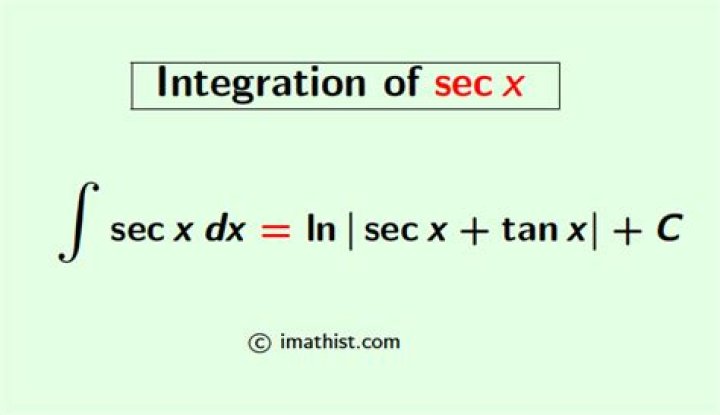
You have to multiply with $\frac{\sec(x) + \tan(x)}{\sec(x) + \tan(x)}$ (), but how do you come up with this idea? Is there a specific reason for that step, or is it just mathematical intuition?
$\endgroup$23 Answers
$\begingroup$Before I learned about $\sec(x)$, the way I used to integrate $\frac{1}{\cos x}$ is to multiply with $\frac{\cos x}{\cos x}$ and substitute $u = \sin x$. You may find that a bit more "natural".
$\endgroup$5$\begingroup$Well, we want to multiply it by some $\frac{f(x)}{f(x)}$ so that $f'(x)=\sec(x)f(x)$ for the $u$-sub.
Let $f(x)$ be of the form $g(x)+h(x)$. We'd want to find some $g(x)$ and $h(x)$ such that $\sec(x)g(x)$ and $\sec(x)h(x)$ have known antiderivatives.
Hm... so what derivatives do we know of that involve $\sec(x)$ multiplied by something...?
Well, that's not particularly hard...
$$\frac{d}{dx}\sec(x)=\sec(x)\tan(x)$$
$$\frac{d}{dx}\tan(x)=\sec^2(x)$$
So we would have $g(x)=\tan(x)$ and $h(x)=\sec(x)$, giving us our $f(x)$.
Then the rest is easy.
$\endgroup$$\begingroup$We had a debate about this in my calculus class - many years ago - because the 'magic trick' you mentioned was discussed but the book ('Thomas' Calculus) used the cosines. I prefer the cosine- partial-fractions method, which I completely spelled out from beginning to end, with several variations, on a math website I wrote several years ago.. originally to preserve things I learned and wanted to save, and for what ultimate purpose I never decided, but feel free to look. You'll probably appreciate the first line.
But dont bookmark; it's been under other names and may be again.
p.s. - the php part of the URL is because not having MathJax or a good math formatter at the time, I invented one for myself that math.php interprets.
$\endgroup$