 $\begingroup$
I found a question how to find the value of cos 180, then we all know that its answer is equal to cos 0, which give us 1 as answer. I myself think that the idea of cos 180 is equal to 1 is :
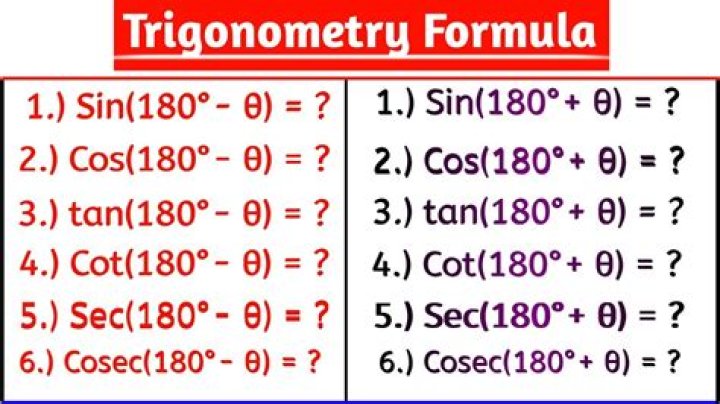
cos 180 = cos(180 - 0) cos 180 = -cos 0 "which is cos(180-a) =- cos a" cos 180 =- 1. cos 180 = cos(270-90) cos 180 = -sin 90 cos(270-a) = -sin a, cos 180 = -1 4 Answers
$\begingroup$In the second line you are using $\cos(A-B)=\cos A\cos B+\sin A\sin B$ but the problem is that you are implying $\cos180=1$ ($\sin180=0$ so that part cancels) to end up with the result $\cos180=1$, which makes your proof "correct", but obviously is incorrect.
There are lots more examples where an incorrect assumption while using a correct identity can make you "prove" that assumption to be true.
$\endgroup$$\begingroup$I'm sorry for my wrong formula, I've found that :
cos 180 = cos (180-0) = -cos 0 = -1 (method 1) cos 180 = cos (270-90) = -sin 90 = -1 (method 2) Thanks to semiclassical, and other answer.
$\endgroup$$\begingroup$This implication
$\begin{align}\cos 180^\circ & = \cos(180^\circ - 0) \\ \cos 180^\circ & = \cos 0\end{align}$
is simply FALSE, the reasoning like this would work for sine, but for cosine you have
$\cos 180^\circ = -\cos(180^\circ - 180^\circ) = -\cos(0) = -1$
$\endgroup$$\begingroup$cos180 = cos(90+90) Using cos(A+B) = cosAcosB-sinAsinB
cos(90+90) = cos90cos90-sin90sin90
= 0*0-1*1 =-1 therefore, cos180 = -1
$\endgroup$1