Prove that there exists a unique monic polynomial of degree $l$ for any points $(\alpha_1,\beta_1), (\alpha_2,\beta_2),...,(\alpha_l, \beta_l),$ $ l\ge 1$, $\alpha, \beta \in \mathbb{K}\times\mathbb{K}$ that interpolates them.
I already know how to prove uniqueness
monic: The number in front of the first term is 1: $1\cdot x^3+x^2+x+1$
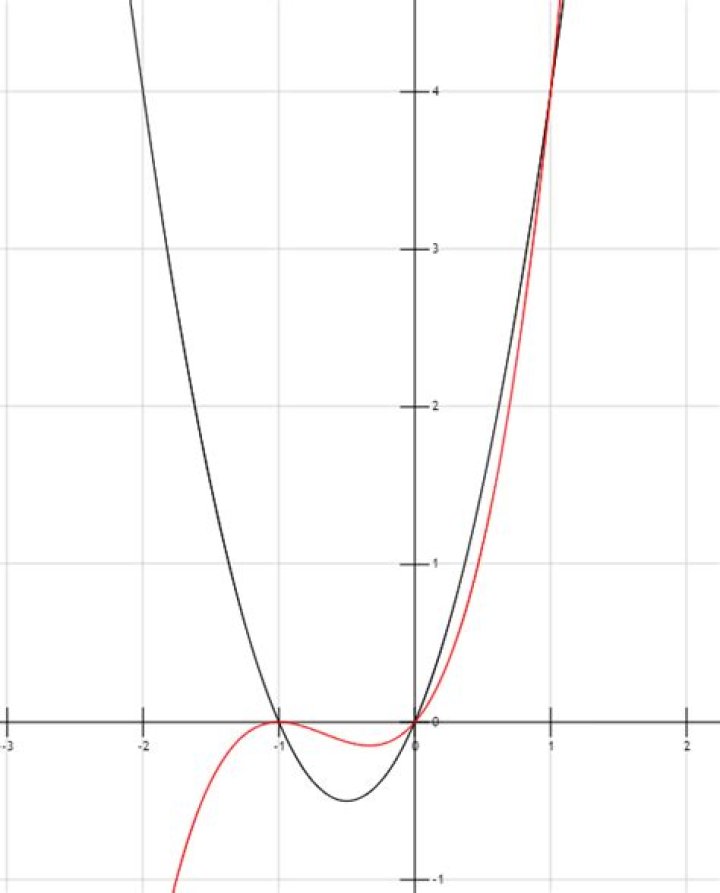
For example, take the points (-1,0), (0,0), (1,4), those get interpolated by $g(x) = 2x^2+2x$ (degree 2). Playing with the values in a plotter shows there exists a polynomial $p(x) = x^3+2x^2+x-0$ of degree 3 that interpolates those points too:

My ideas:
(1) At any rate, we have to find a rule to constructs the monic term.
(2) The Newton-Interpolationformula-algorithm gives us the polynomial of degree l-1, we can probably reuse this to construct the higher-degree-polynomial.
$\endgroup$42 Answers
$\begingroup$You can try this. Suppose the polynomial is $$a_0+a_1x+\cdots+a_{l-1}x^{l-1}+x^l=y.$$
Putting the last term to the right hand side, we get $$a_0+a_1x+\cdots+a_{l-1}x^{l-1}=y-x^l.$$
Now use Newton's interpolation on the points:
$$\{(\alpha_i, \beta_i-\alpha_i^l)| i=1,\dots, l\}.$$
This means, treating $\beta_i-\alpha_i^l$ as the $y$ values. So the problem transforms to the original problem of finding a unique polynomial of degree $l-1$ with $l$ points.
$\endgroup$2$\begingroup$Suppose you have the desired monic polynomial $$ p(x)=a_0+a_1x+\cdots+a_{k-1}x^{k-1}+x^k $$ for $(x_i,y_i)$ with $i=1,\cdots, k$. One should assume that all these points are distinct. Then the condition $p(x_i)=y_i$ gives you a linear equation on the $a_i$'s. The solution of the linear equation gives you the existence of $p(x)$.
Now what you need is knowing the property of Vandermonde matrix.
$\endgroup$