 $\begingroup$
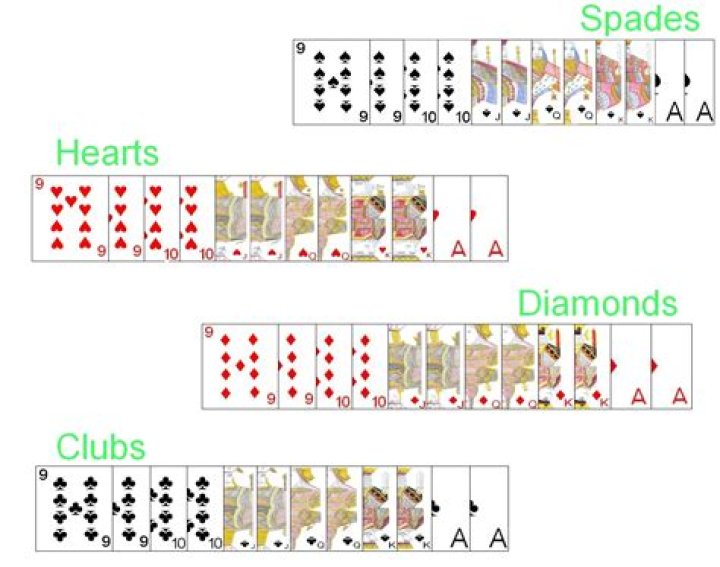
What is the probability of drawing a heart and then a spade in 2 successive draws from a standard deck of cards? Do we consider these as independent events thus yielding:
$$\Pr(\text{Spade and Heart})=\Pr(\text{Spade})\times\Pr(\text{Heart})\rightarrow\frac{13}{52}\times\frac{13}{52}$$
or conditional so that:
$$\Pr(\text{Spade then Heart})=\Pr(\text{Spade})\times\Pr(\text{Heart})\rightarrow\frac{13}{52}\times\frac{13}{51}$$
$\endgroup$21 Answer
$\begingroup$A couple of clarifying points.
- "Drawing a heart and a spade" is a different statement than "Drawing a heart then a spade."
- One might assume that "successive draws" indicates that the draws are dong without replacement, but it's not explicitly stated.
If you're wanting to draw a heart and a spade, then you could get the heart first, or the spade first. The probability of doing this with replacement is $2(1/4)(1/4) = 1/8$. Doing it without replacement is $2(1/4)(13/51) = 13/102$. (The $2$ out front considers heart then spade, and spade then heart.)
If you're drawing a heart then a spade, the answers are half as much, because you must get the heart first.
$\endgroup$