 $\begingroup$
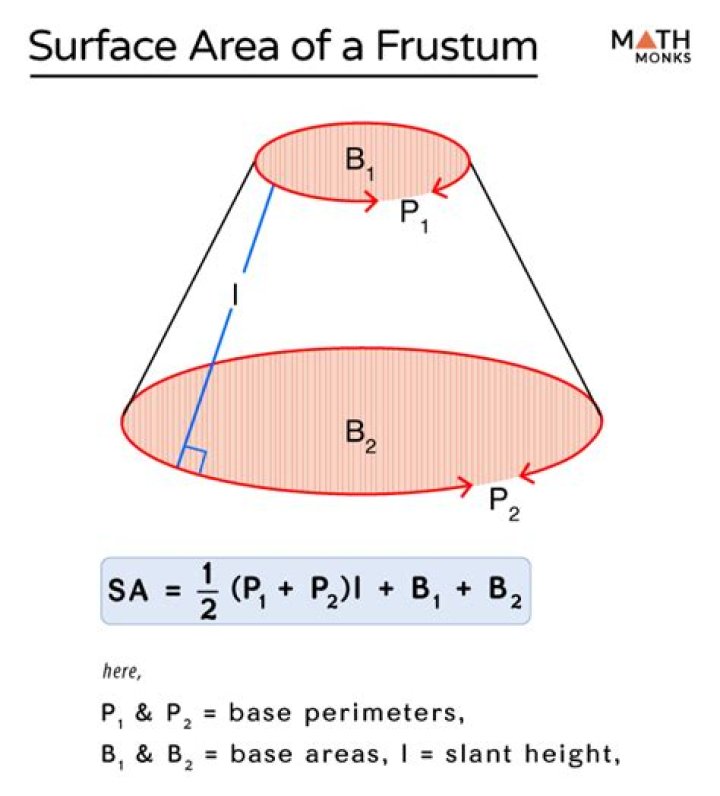
A cone is divided into two parts: upper part is a small cone and the lower part is a frustum. Given: Radius of frustum( R) =10, radius of upper cone( r)= 5, slant height of frustum (S)= 12, Slant height of whole cone= 20, slant height of upper cone (s)= 8 I tried to find the lateral surface area of a frustum of a cone. First I used: phi X (R+r) X s. Then I used another method: lateral surface area if big cone minus that of small cone. But the results are different. The first is 3.14 x (10+5) x 12= 565.2. The second is (3.14 x 10 x 20) - (3.14 x 5 x 8)=502.4 Please help!
$\endgroup$11 Answer
$\begingroup$You don't really have a cone here. See that the ratio of radius to slant height of the small cone is $5/8$. For the big cone it is $10/20$ and for the frustum the equivalent ratio is $5/12$. None of these ratios are equal to each other. If you change the slant height of the small cone to $12$, then things would work out.
$\endgroup$2