How do you determine singular points of the equation
$$(x^2 - 4)^2y'' + (x - 2)y' + y = 0?$$
It says $x = -2$ and $x = 2$ are singular points of the equation. Do you just put whatever is in the front of $y''$ and equal it to zero and find the $x$'s and those become the singular points of the equation?
$\endgroup$1Please show it in the simplest and easiest way. Thank you
2 Answers
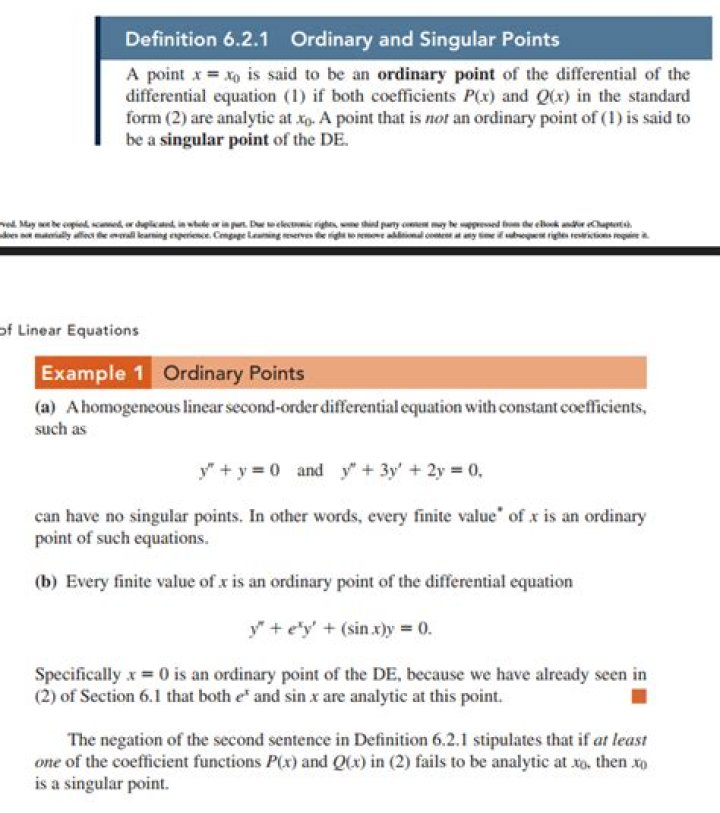
$\begingroup$You certainly know that in OE: $$y^{''}+P(x)y'+Q(x)y=0$$ the point $x=x_0$ is said to be a regular singular point if bpth of: $$(x-x_0)P(x),~~(x-x_0)^2Q(x)$$ are analytic at $x_0$. This means that these two functions have power series in $(x-x_0)$ with $R>0$. A singular point that is not regular is called irregular singular point of that ODE. Here, you have $$(x^2 - 4)^2y'' + (x - 2)y' + y = 0$$ so $$P(x)=\frac{1}{(x+2)^2(x-2)},~~Q(x)=\frac{1}{(x+2)^2(x-2)^2}$$ Now if $x=-2$ wants to be regular singular point so the factor $(x+2)$ should be of power at most $1$ in $P$ and be of power $2$ at most in $Q$ which is not right. Its power in $P$ is $2\neq 1$, so this point is an irregular one.In fact, the function $P$ has not a Taylor series at $x=-2$. Do the same way for another point $x=+2$ to see that it is a regular singular point. See the plot of $P(x)$ near $x=2$ in an neighborhood.

First, you should write the ode in the form
$$ y''+p(x)y'+q(x)y=0,$$
then you look for the singularities.
Example:
$$ x^2 y''+ x y'+ y=0 \implies y''+\frac{1}{x}y'+ \frac{1}{x^2}y=0 $$
which shows that the point $x=0$ is a regular singular point.
$\endgroup$2