Can someone please explain how to proceed with this question, or maybe give me hints as to how to do it? I am not familiar with concave polygons at all, so any help with that as well would be greatly appreciated. Thanks.
$\endgroup$23 Answers
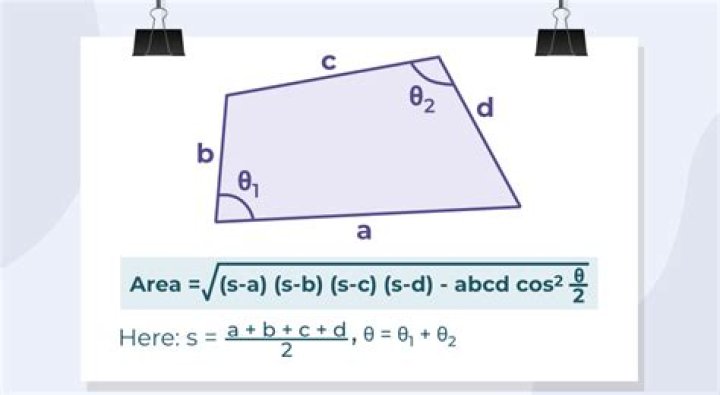
$\begingroup$join diagonal AC. Your quadrilateral will get divided into two triangles ABC , ADC. Find area of triangle ABC using Heron's formula. Then find value is ADC . So area of ADC is 13.5. you know AC is √50 so find the corresponding height of triangle which will come out to be 27/√50.
Now find the eq of line AC and use the formula for finding distance of point D from AC and equate it with 27/√50.
Now A(5,-2);C(-2,-3). So slope of line AC =-2+3/5+2=1/7.
y+3/x+2=1/7
Which will give you eq x-7y-19=0
Now according to the formula of distance of a point from line 27/√50=|a(x1)+b(y1)+c|/√(a^2+b^2) =|1×-1+-7×k-19|/√49+1 =.| -7k-20| /√50 |-7k-20|=27
-7k-20= 27 or -27
-7k-20=27 k=47/-7= -47/7
-7k-20=-27 k=-7/-7=1
You will get value of k as 1 and -329/49
1+(-47/7)=-40/7
$\endgroup$13$\begingroup$- Find [$\triangle ABC$] = a known value = s, say.
Find p from [$\triangle D_1 CA$] = 18.5 – s. Since p is the only unknown in that equation, its value can be found.
Similarly, find q from [$\triangle D_2 CA$] = 18.5 + s
Find $p \over q$.
Let $D_1$ be the required point for which the specified quadrilateral is convex.
Let $D_2$ be the required point for which the specified quadrilateral is concave.
Then $\text{area}(AD_1CB) = \text{area}(ABCD_2) = {\displaystyle{\frac{37}{2}}}$.
For this problem, it's natural to apply the Surveyor's Formula . . .
First, we get the area of quadrilateral $AD_1CB$:
$\text{}$ \begin{align*} \text{area}(AD_1CB)&= \small{ \frac{1}{2} \left( \left| \begin{matrix} 5 & -1\\ -2 & k\\ \end{matrix} \right|+ \left| \begin{matrix} -1 & -2\\ k & -3\\ \end{matrix} \right|+ \left| \begin{matrix} -2 & 1\\ -3 & -4\\ \end{matrix} \right|+ \left| \begin{matrix} 1 & 5\\ -4 & -2\\ \end{matrix} \right| \right) } \\[6pt] &= {\small{ \frac{1}{2}}} \bigg( (5k-2)+ (3+2k)+ (11)+ (18) \bigg) \\[6pt] &= {\small{\frac{1}{2}}} \left(7k + 30\right) \\[6pt] \end{align*}
Then
\begin{align*} &\text{area}(AD_1CB) = \frac{37}{2}\qquad\qquad\qquad\;\;\;\;\\[6pt] \implies\; &{\small{\frac{1}{2}}}\left(7k + 30\right) =\frac{37}{2}\qquad\qquad\qquad\\[6pt] \implies\; &k = 1\\[6pt] \implies\; &D_1 = (-1,1) \end{align*}
$\text{}$ Next, we get the area of quadrilateral $ABCD_2$:
$\text{}$
\begin{align*} \text{area}(ABCD_2) &= \small{ \frac{1}{2} \left( \left| \begin{matrix} 5 & 1\\ -2 & -4\\ \end{matrix} \right|+ \left| \begin{matrix} 1 & -2\\ -4 & -3\\ \end{matrix} \right|+ \left| \begin{matrix} -2 & -1\\ -3 & k\\ \end{matrix} \right|+ \left| \begin{matrix} -1 & 5\\ k & -2\\ \end{matrix} \right| \right) } \\[6pt] &= {\small{ \frac{1}{2}}} \bigg( (-18)+ (-11)+ (-2k - 3)+ (2-5k) \bigg) \\[6pt] &= {\small{-\frac{1}{2}}} \left(7k + 30\right) \\[6pt] \end{align*}
Then
\begin{align*} &\text{area}(ABCD_2) = \frac{37}{2}\qquad\qquad\qquad\;\;\;\;\\[6pt] \implies\; &{\small{-\frac{1}{2}}}\left(7k + 30\right) =\frac{37}{2}\qquad\qquad\qquad\\[6pt] \implies\; &k = -\frac{67}{7}\\[6pt] \implies\;&D_2 = \left(-1,-\frac{67}{7}\right) \end{align*}
Hence the sum of the two required values of $k$ is $$1 - \frac{67}{7} = -\frac{60}{7}$$
$\endgroup$