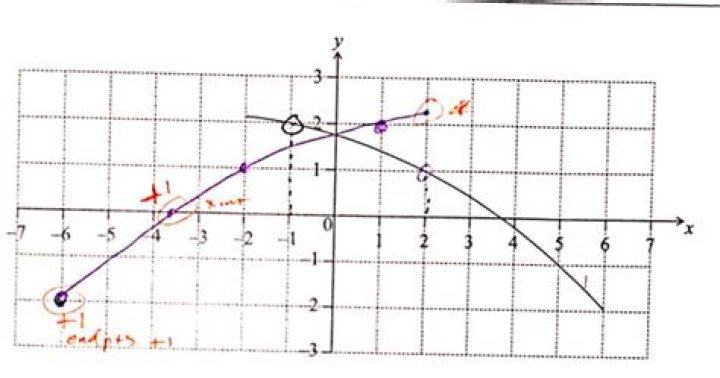
A question has a diagram of function f, with no function given (please ignore the purple line): 
If I wanted to find $f^{-1}(-1)$, would I draw the inverse of f along the x=y line and then find what $y$ is at $x=-1$?
So in this case, would the answer be $f^{-1}(-1)=5$?
$\endgroup$13 Answers
$\begingroup$Assuming you are plotting the function $y=f(x)$, draw the line $y=-1$ on the same diagram. The points where the line cuts the graph of $f$ are the points $(f^{-1}(-1),-1)$. You just need to draw vertical lines on each of those points to get the corresponding values for $x$.

$y= f^{-1}(x)$ is, by definition, the number, y, such that x= f(y). Given the graph of f (which is, I think, what you mean by "diagram"), start by marking the given value of x on the y- axis, go horizontally to the graph then then vertically to the x-axis to determine the value of y. The point is that taking the inverse function "swaps" x and y.
$\endgroup$$\begingroup$It may help for you to think that you want to find $x = f^{-1}(-1)$ so applying $f$ to both sides, we get $$f(f^{-1}(-1)) = f(x)$$ But we know that $f f^{-1} (m) = m$ so we get $$f(x) = -1$$ which is something I'm sure you can do.
$\endgroup$