I stumbled upon this "easy" problem from geometry....that I cannot solve :(
We are told that $D$ is a dilation that transforms the circle defined by $$x^2 - 6x + y^2 - 8y = -24$$ point by point onto the circle defined by $$x^2 - 14x + y^2 - 4y = -44$$ We are asked to find the magnitude of the dilation and the center of the dilation.
Finding the magnitude is pretty easy (just put the equations in standard form, and find the ratio of the radii). However, I cannot figure out how to find the center of the dilation.
The hint is:
Then the center of the dilation can be found by using the vectors from center to small circle, and from small circle to large circle.
Can anyone explain to me how to do this, so that I can solve this high school problem?
$\endgroup$13 Answers
$\begingroup$
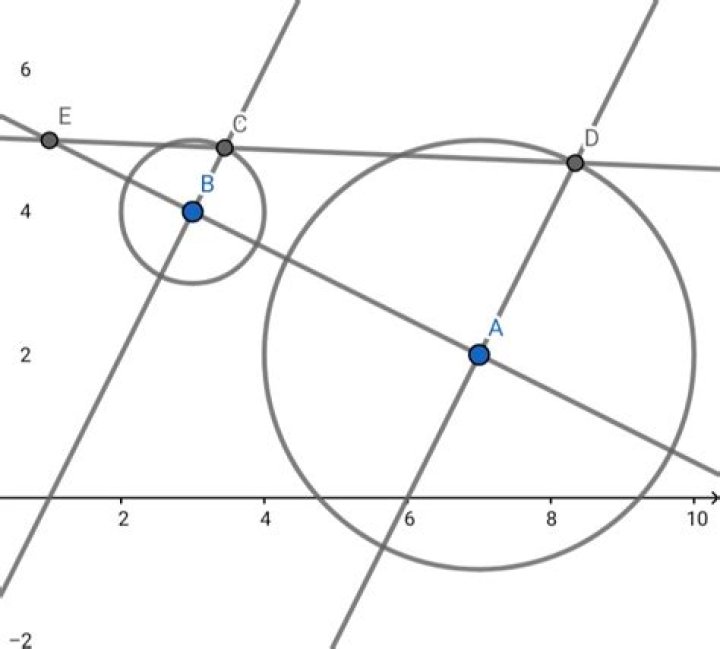
You need any two pairs of non-colinear homologous points two determine the dilation point. Here, I've taken one pair as $(C, D)$ and the other is points lying on the line joining centres of both the circles. Intersection of the two lines is the dilation point. Also, see this.
Another way to find the center of dilation is to consider the intersection point of direct common tangents since the point of contacts of both the circles are homologous, too. See @Andrei's comment for transverse common tangent. Image for reference.
$\endgroup$5$\begingroup$Here is a solution based on the computation of pairs of (common) tangents. This is done by using a powerful formula (ill) known as $(SS_1-T^2)=0$. Knowing this very general formula can be useful for treating potentially more complicated issues of a similar type, even if in this case it could be considered as "overkill". A drawback of this formula (but is it really one ?) is that it necessitates the use of a CAS (Computer Algebra System).
Let us first recall that the tangent in $(x_0,y_0)$ to a conic curve with equation
$$S(X):=ax^2+by^2+2cxy+2dx+2ey+f=0 \ \text{where} \ X=(x,y)\tag{1}$$
is
$$T(X,X_0):=axx_0+byy_0+c(xy_0+x_0y)+d(x+x_0)+e(y+y_0)+f=0\tag{2}$$
Now, the main formula, currently taught in the early 20th century, but largely unknown in 2020:
Theorem (formula $SS_1-T^2=0$): the cone issued from $(x_1,y_1)$ and tangent to a conic curve with equation (1) is given by formula:
$$S(X)S(X_1)-T(X,X_1)^2=0\tag{3}$$
Of course, in 2D, replace "cone" by "pair of tangent line equations". But it is important to know that this formula is generalizable to 3D and even nD.
A 3D example can be found here.
In our case, we are going to do the inverse path: we will be looking for points $X_0=(x_0,y_0)$ such that equation (3) is fullfilled for our 2 circles with equations, $S_1=0$ and $S_2=0$.
As we have $4$ common tangents, we must await $6=\binom{4}{2}$ pairs of tangents and in particular $6$ intersection points of these pairs of tangents that are depicted (red dots) in the figure, among which we will find the two dilation centers, the positive one and the negative one
$$(1,5) \ \text{and} \ (4,7/2)$$
More precisely, but without entering into the details, it suffices to compare the coefficients of $x^2$, $xy$ and $y^2$ in the expansions of $$S_1(X)S_1(X_0)-T_1(X,X_0)^2=0 \ \text{and} \ S_2(X)S_2(X_0)-T_2(X,X_0)^2=0$$ to get the following system :
$$\begin{cases}(y_0^2 - 8y_0 + 15)&=&a(y_0^2 - 4y_0 - 5)\\ (8x_0 + 6y_0 - 2x_0y_0 - 24)&=&a(4x_0 + 14y_0 - 2x_0y_0 - 28)\\ (x_0^2 - 6x_0 + 8)&=&a(x_0^2 - 14x_0 + 40)\end{cases}\tag{4}$$
($a$ being a proportionnality coefficient ; all this is to be done of course by a CAS).
(4) is a system of 3 equations with three unknowns. Its solutions are the 6 points:
$$(x_0,y_0)=(6,5),(4,1),(1,5),(4,5),(4,7/2), (14/5,13/5)$$
that we can see on the figure.
For a proof of the formula, see #278 (page 251) and #289 of the book by Loney (not a recent one, I admit)
$\endgroup$1$\begingroup$Center of dilation $P(4;\;3.5)$
Magnitude $=-3$
Indeed centers are respectively $A(3;\;4)$ and $B(7;\;2)$ and radii $r_1=1;\;r_2=3$
The center of dilation is on the line $AB$ at a point $P$ such that $\vec{PB}=-3\vec{AP}$.
$\endgroup$1