 $\begingroup$
The original 24 m edge length x of a cube decreases at the rate of 2 m/min. Find rates of change of surface area and volume when x = 6 m.
I don't even know where to begin.
$\endgroup$2 Answers
$\begingroup$Well, since you are given that the object is a cube, you know that each side has a length of $x=24~m$. But you are told that $x$, the variable which represents the length of the sides, is changing with time. But how is it changing with time? It is decreasing. So, every second that passes, you are subtracting from the length of the cube. How can this be expressed mathematical (think derivatives, $\displaystyle \frac{dx}{dt} = ~ ?$).
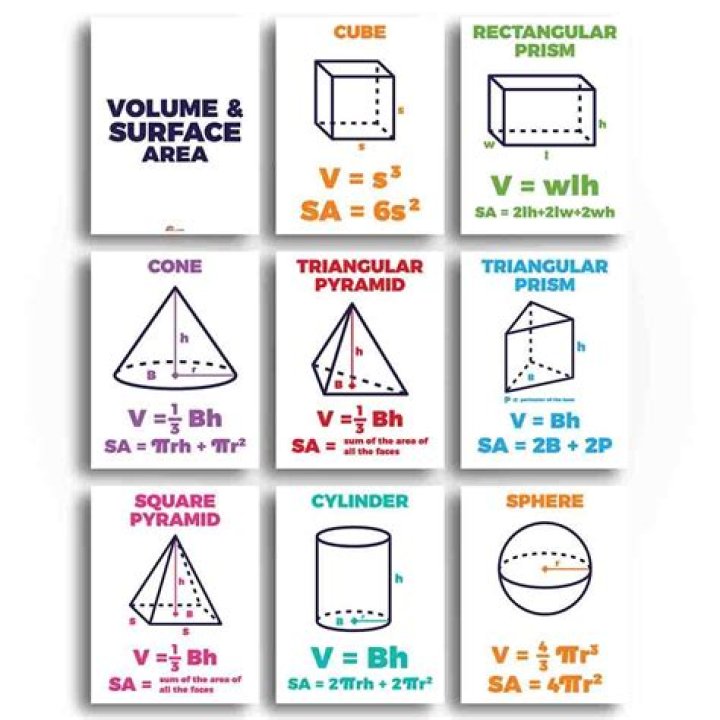
Once you figure this out, think about how the length of the sides of the cube is related to its volume and surface area. The formula for its volume is $V(x) = x^3$; and for its surface area, $A(x) = 6x^2$. What happens as x changes? Won't the area and volume change as well?
Let me know if you need additional help.
$\endgroup$0$\begingroup$The formulas for finding the surface and volume of a cube are:
$S(x)=6x^2$ and $V(x)=x^3$ respectively, with $S$ being the surface, $V$ the volume and $x$ the edge of the cube.
And due to the decrease, they become: $S(x)=6x^2-2^2$ and $V(x)=x^3-2^3$
By deriving those, we get the functions: $S'(x)=12x$ and $V'(x)=3x^2$ which represent the rate of change (since that's what a derivative essentially is) of the surface and cube.
Now, for a given $x=6m$, we have: $S'(6)=12*6=72$ and $V'(6)=3*6^2=108$.
$\endgroup$