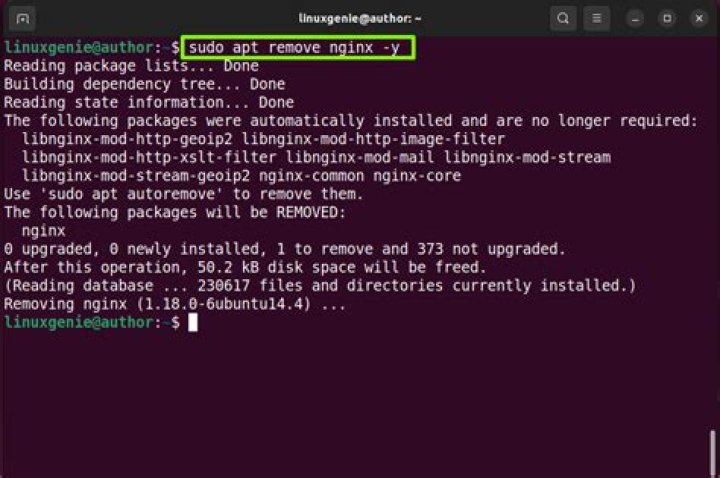

I have been experimenting with nginx as a webserver for php files. I come from an Apache background but I wanted to try it. I recently had an issue with it and needed to switch back to Apache. I removed it using apt-get remove nginx.
This worked fine and I installed Apache and life was good. I restarted my computer and somehow nginx started up. I didn't understand. I tried to remove it again and I got the message:
$ sudo apt-get remove nginx Reading package lists... Done Building dependency tree Reading state information... Done Package 'nginx' is not installed, so not removed 0 upgraded, 0 newly installed, 0 to remove and 2 not upgraded. If I look for the program (screenshot):
$ which nginx /usr/sbin/nginx Does anyone know if I am doing something wrong or what the next step to removing it would be?
I am using Xubuntu 14.04.
22 Answers
nginx is a metapackage, so you need to remove whatever was installed by this package. If doing sudo apt-get autoremove doesn't do the trick, you can run sudo apt-get remove nginx-core nginx-full nginx-light nginx-extras nginx-naxsi nginx-common (you probably have only one of these packages installed, but the command shouldn't fail).
sudo apt-get remove --purge nginx* will remove whatever is installed and is related to nginx, including configuration files. It will also list packages available in repositories which match the regex nginx* and are not installed.
There is a difference between apt-get remove and apt-get purge. The --purge option removes also the configuration files. It is useful for a clean reinstall.
Typing the command:
sudo apt-get remove --purge nginx* will result in:
The following packages will be REMOVED: nginx-common* 0 upgraded, 0 newly installed, 1 to remove and 0 not upgraded. After this operation, 0 B of additional disk space will be used. Do you want to continue [Y/n]? (Reading database ... 55416 files and directories currently installed.) Removing nginx-common ... Purging configuration files for nginx-common ...